Conjunction (0°) in Astrology: The Fusion of Two Planetary Energies
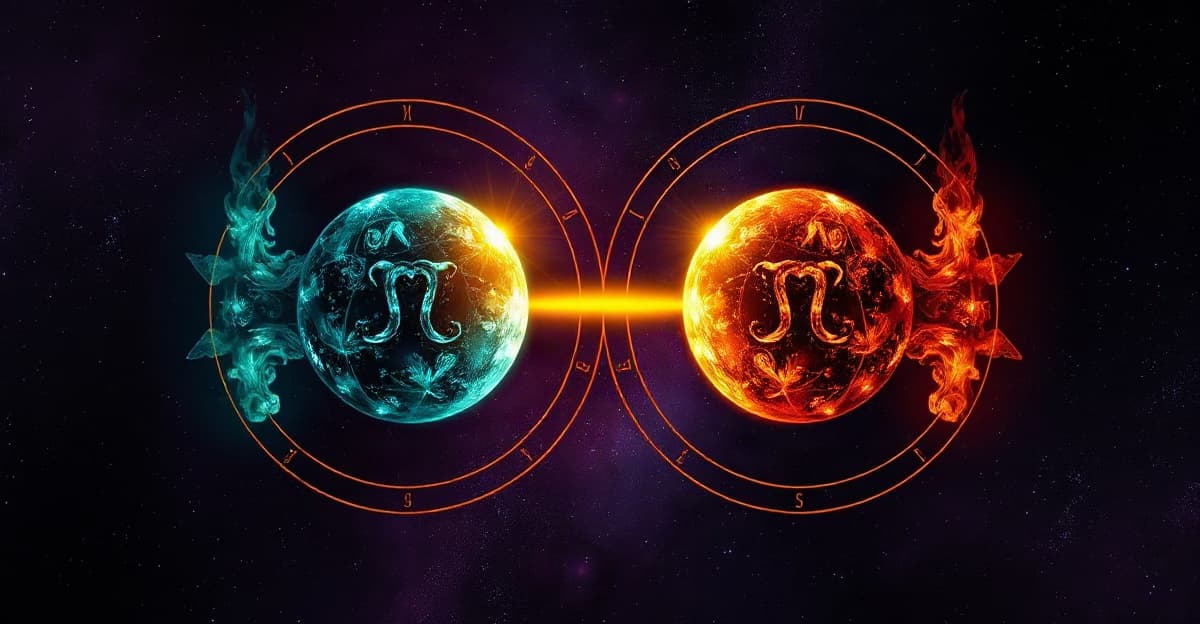
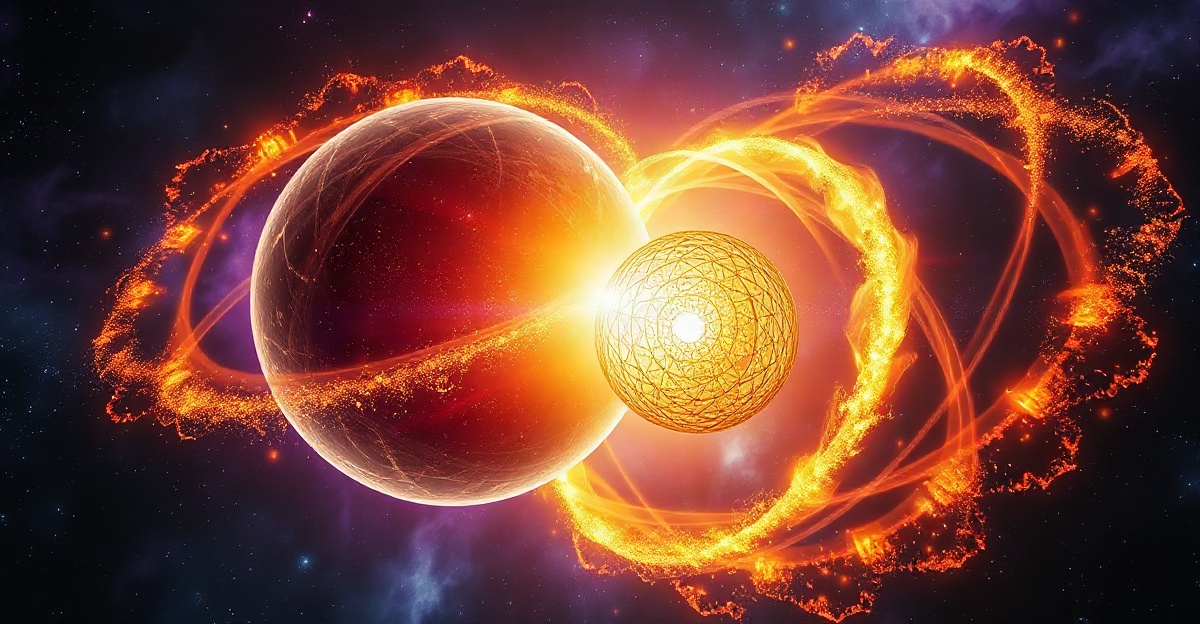
Conjunction (0°) is the foundational and most powerful of all astrological aspects. It is not a "link" and not an "interaction"; it is the literal fusion of two planetary energies at one point in the chart. Picture two people in a room: if they stand side by side, breathe the same air, whisper into one ear — that is a conjunction. Not "they are talking to each other" (that is more like a sextile), not "they are arguing" (that is a square), but "they have literally become one and now act as a single energy".
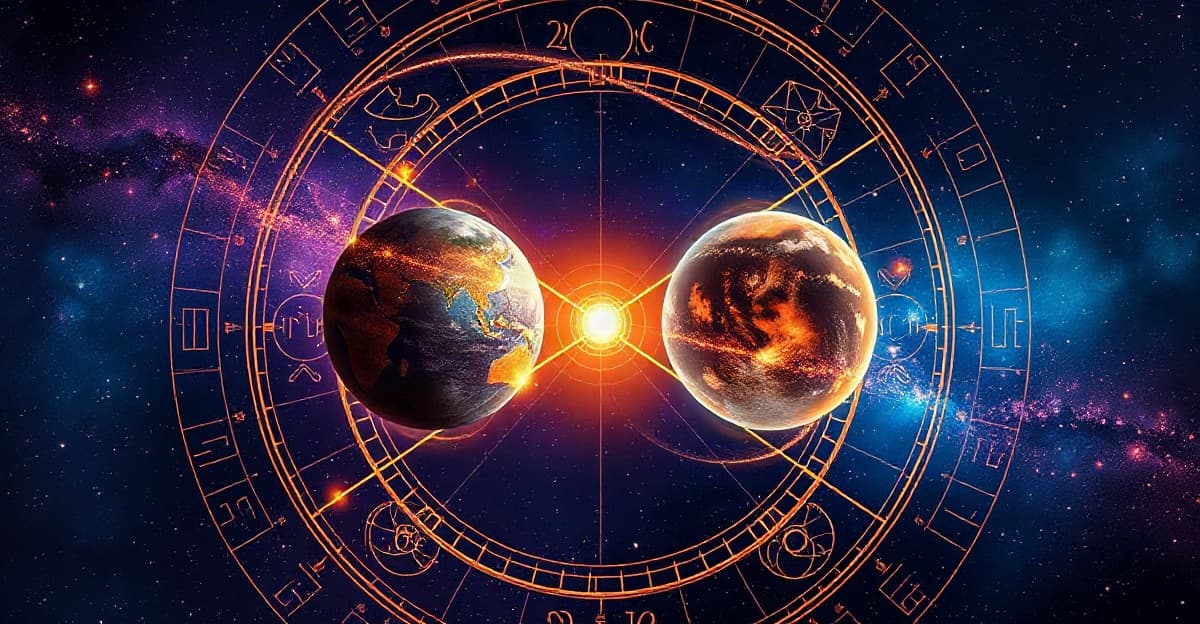
In the natal chart a conjunction happens when two planets sit at the same degree of the zodiac (or within 8-10 degrees — the aspect's orb). Between the 10 planets of astrology there are 45 possible pairs, and each carries its own signature note. This is the fundamental aspect from which all others are measured: sextile — 60° from conjunction, square — 90°, trine — 120°, opposition — 180°. So the study of aspects begins with conjunction.
The astrological essence — a fusion of two energies
Every planet in astrology is a distinct psychic force. The Sun — identity, the Moon — emotional memory, Mercury — mind, Venus — love, Mars — will, and so on. When two planets are conjunct they no longer act separately. They are literally welded into one channel of energy, and the person experiences them as one complex note, not two separate ones.
Example: a conjunction of Mercury and Venus (both at 15° Libra). Mind and love in a single channel. This person does not "think first, then love"; they think lovingly, speak about beauty, communicate aesthetically. Their mind is coloured by Venus, their love rationalised. It is not two processes, but one — and its style is entirely unique.
Types of conjunctions — soft, tense, mixed
All conjunctions are fused, but not all are equally pleasant. The nature of the planets defines how they cohabit in one channel:
Soft conjunctions — when the planets are compatible by nature. Sun-Venus — beauty and identity in one; Moon-Jupiter — generous emotions; Venus-Jupiter — abundant love. These conjunctions usually work without inner conflict.
Tense conjunctions — when the planets have opposing natures. Moon-Saturn — emotional coldness, fear of attachment; Mars-Saturn — blocked will; Venus-Pluto — obsessive love. These conjunctions create inner tension, but through it the person grows.
Transformational conjunctions — involving outer planets (Uranus, Neptune, Pluto). Sun-Pluto — a deep transformational identity; Moon-Neptune — a sensitive dreamer; Mercury-Uranus — a lightning mind. These conjunctions grant extraordinary abilities but also complicate life.
Conjunction with the Ascendant — the planet "on the mask"
A special case is a conjunction of a planet with the Ascendant. It means the planet literally stands on the "stage of stepping into the world", and it colours the whole appearance far more strongly than just the Ascendant sign does.
For instance: Libra Ascendant (soft, pleasant) + Mars conjunct the Ascendant = the person looks pleasant but with a note of combativeness. Or: Capricorn Ascendant (serious) + Venus conjunct the Ascendant = a serious facial expression, but with unusually pleasing features. A planet on the Ascendant is an "amplifier" through which everything else passes.
Conjunction in life — examples of typical pairs
Sun-Moon (new moon chart). A person with Sun and Moon in conjunction was born on a new moon. Their identity and emotions are one whole; they are not split between "I want to be" and "I feel", they live in them as one. Such people often have a very unified character, but a restricted range — self-criticism works with difficulty because both the assessor and the object are the same energy.
Mercury-Mars. Mind and will in one. A sharp tongue, a fast reaction, an ability to argue without hesitation. Such people are natural debaters, sports commentators, salespeople, surgeons. Shadow — a tongue so sharp it wounds the closest.
Venus-Saturn. Love and discipline. Either the person postpones relationships until thirty or forty, or they immediately find one lifelong partner. Not a light flirt; seriousness, devotion, sometimes heavy relationships. In maturity it yields extraordinarily stable marriages.
Jupiter-Neptune. Generosity and spirituality. Often manifests as religiosity, philosophical breadth or creative flight. Shadow — over-idealisation, disillusion in imagined ideals.
Pluto-Sun. Identity through transformation. Such people pass through several life rebirths; each new stage is a new person. Magnetic presence, capacity for deep power over self and others.
Orb — the aspect's strength depends on exactness
The orb of a conjunction is the allowable distance in degrees within which the aspect still works. The classical rule: for a conjunction between two planets the orb is 8-10 degrees (10° for Sun and Moon, 8° for the rest). But the strength of the aspect depends directly on precision: an exact conjunction (0-1°) works ten times stronger than one within 8°.
This matters in practice: if your Sun is at 5° Aries and Mars at 6° Aries — that is an extremely precise conjunction and it dominates the character. If Sun is at 5° Aries and Mars at 12° Aries — the conjunction is technically present but weaker; you may experience it as a "light influence" rather than a central life theme. That is why professional astrology software shows conjunctions with degree precision — so you know which ones truly matter and which are background tones.
The shadow of conjunction — when energies smother each other
Although a conjunction often looks like "amplification", it has a specific shadow: the planets cannot separate and rest from one another. A person with a Moon-Mars conjunction cannot "just quietly grieve" — their grief always has a note of anger, and their anger always has a note of grief. This is not bad character; it is literally the fusion of two channels that are naturally separate.
Especially heavy are conjunctions of personal planets with Saturn or Pluto. Moon-Saturn — emotions are never light, always with a note of heaviness. Mercury-Pluto — thoughts are always deep, never surface-level, and that is draining. These configurations require conscious therapeutic work so the person learns to distinguish inner voices and give each energy its own space despite the fusion.
How to use an understanding of conjunction
Conjunction is the strongest but also the simplest aspect to understand. Three things help:
First, find your conjunctions on the chart. In a natal chart they look like planets standing side by side (within 10° of each other). Look primarily at conjunctions of two personal planets (Sun, Moon, Mercury, Venus, Mars) — they form the core of your nature. Conjunctions of personal with social planets (Jupiter, Saturn) shape destiny. Conjunctions with outer planets (Uranus, Neptune, Pluto) are generational.
Second, learn the note of each conjunction not as "just two planets" but as a distinct entity. Mercury-Mars is not "mind + will"; it is a specific psychological type — "the sharp tongue". Venus-Jupiter is not "love + luck"; it is "generous loving". Do not add — synthesise.
Third, look for conjunctions with the axes (Ascendant, MC, IC, DSC). A planet in conjunction with the Ascendant strongly affects appearance. With the MC — career. With the IC — home and parents. With the DSC — the partner. These "axial conjunctions" often carry more weight than inter-planetary ones.
Read also: the 10 planets of astrology, the 12 houses of the horoscope, the 12 zodiac signs, what is the Ascendant. And to see your conjunctions with degree-level precision — calculate your chart through the Astrokolo astro-processor.