Opposition (180°) in Astrology: The Aspect of Axis, Projection and Mature Synthesis
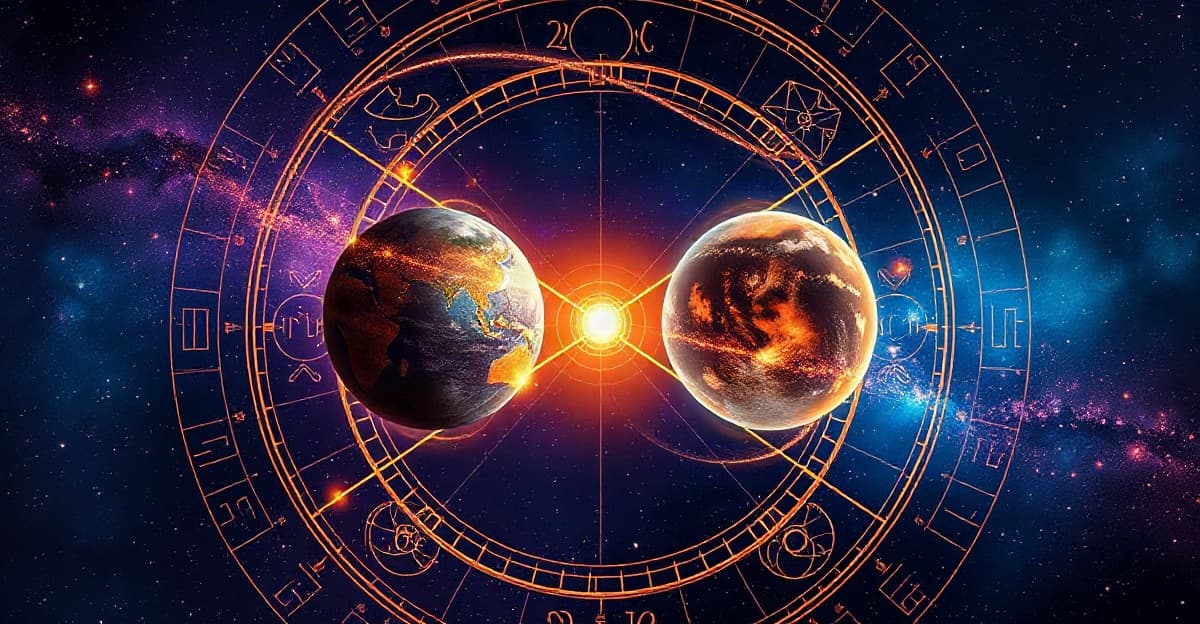
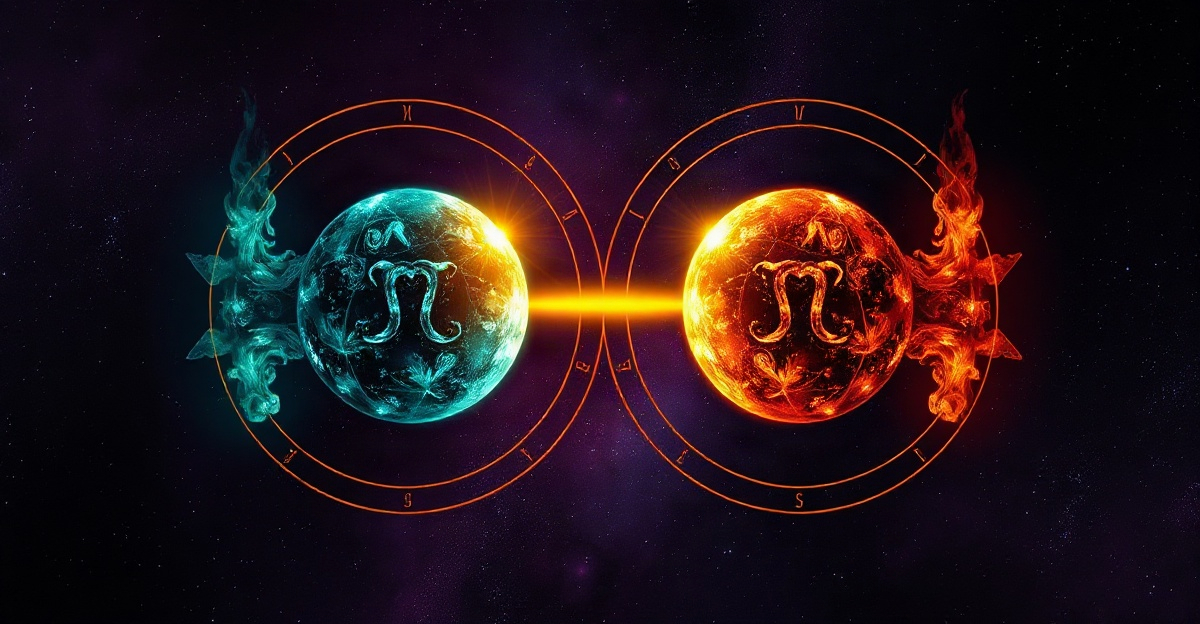
The opposition (180°) is the aspect of greatest distance and greatest mutual dependence. Two planets stand facing each other across the whole chart: they see each other completely, like two people at opposite ends of a table, and that is exactly why they cannot be ignored. If a conjunction fuses two forces into one and a square makes them press against each other, an opposition stretches a person between two poles, each of which is right in its own way.
Geometrically, 180° is the distance between signs of the same modality and of opposite but complementary elements: fire against air, earth against water. Aries and Libra, Taurus and Scorpio, Gemini and Sagittarius are pairs that need each other even while they argue. The nature of modalities and elements is covered in the guide to the 12 zodiac signs, and the six axes of the chart in the guide to the 12 houses of the horoscope.
The Astrological Essence — A Pendulum Between Two Poles
An opposition works like a swing. A person lives in one pole for a long time, then flips sharply into the opposite one, then back again — and so on until they find a third point: a conscious balance in which both forces get their due. The classic scenario: ten years of complete devotion to work, then an abrupt leap into family and privacy, then a sharp sense that self-realisation has disappeared again.
Example: the Sun in Aries opposite the Moon in Libra. The Sun wants to go first, decide alone, stand up for itself. The Moon in Libra needs partnership, agreement, a shared decision. Such a person either acts bluntly and then feels guilty, or agrees for too long and then resents their own softness. The mature version is learning to say "this is what I want" without aggression and to hear "and this is what I want" without losing themselves.
Oppositions Between Personal Planets — An Inner Dialogue
Oppositions between the inner planets describe the basic inner conflict a person has carried since childhood:
Sun opposite Moon. The person was born around a full moon. Will and feelings look in different directions: "I must" against "I want", career against home, the father's model against the mother's. The gift of this aspect is an extraordinary ability to understand both sides of any conflict.
Mercury opposite Jupiter. Detail against the whole. The person either sinks into small print and loses perspective, or speaks in broad strokes and misses the facts. The mature version is a talent for combining deep analysis with the big picture — in other words, genuine expertise.
Venus opposite Mars. Closeness against autonomy. The classic push-pull dynamic in relationships: as soon as a partner gets too close, you want space, and as soon as the distance grows, you want fusion. A worked-through opposition gives very alive, hot, yet stable relationships.
Oppositions With Social Planets — Freedom Against Duty
When an opposition involves Jupiter or Saturn, it sets a major biographical theme:
Sun opposite Saturn. The self against limits and authorities. In youth, a sense that someone is constantly in the way: a strict father, a boss, the system. In maturity, a deep inner authority over oneself that cannot be gained without this friction.
Moon opposite Saturn. The need for warmth against the duty to be strong. Often a cold or overly demanding childhood and a habit of never showing weakness. The lesson is to allow oneself to lean on others without losing resilience.
Jupiter opposite Saturn. Risk against safety, expansion against economy. For years the person swings between "I have to leap" and "I have to hedge". The mature synthesis is the ability to grow carefully — something neither a pure optimist nor a pure pessimist can do.
Oppositions With Outer Planets — Conflict With the Spirit of the Times
Oppositions with Uranus, Neptune and Pluto take the tension beyond the personal:
Sun opposite Uranus — the self against the need for freedom. Sudden breaks, changes of course, conflicts with any structure that restricts. It gives originality but costs stability.
Moon opposite Neptune — real feelings against idealised ones. A tendency to invent other people's motives, disappointment in loved ones, strong empathy without boundaries. Worked through, it becomes a rare therapeutic or artistic gift.
Mars opposite Pluto — personal will against a force bigger than you. Sharp confrontations, power struggles, formidable opponents. The mature version is enormous composure and the ability to stay out of other people's wars.
Projection — The Main Mechanism of an Opposition
More than any other aspect, an opposition shows up through the people around you. The pole a person does not acknowledge in themselves they recognise in someone else — and that is exactly why they attract partners, bosses or rivals who embody it. A woman with a Venus-Saturn opposition complains about cold partners; a man with a Mars-Neptune opposition keeps running into "incomprehensible" people who derail his plans.
This is not coincidence but a mechanism: the chart shows both ends of the axis as parts of one person. Adult work with an opposition begins with the question "where is this in me?". As soon as the person reclaims the disowned pole, external conflicts quiet down, because they stop being the only way to see the other half of oneself. This is also why oppositions matter so much in synastry — they describe not only inner but also relationship dynamics.
The Orb of an Opposition and Its Shadow
The classic orb of an opposition is 6-8 degrees; an exact opposition (0-1°) sounds through life almost daily. The shadow of the aspect is getting stuck in one pole and demonising the other: "I'm normal, they're the toxic ones". That is how an opposition turns into a chronic external conflict that repeats with new people.
The second shadow is an endless pendulum without synthesis: for decades the person swings between work and family, freedom and stability, never holding the tension long enough to find a third option. The opposition matures latest of all aspects — often after 40, when the patience appears to hold both poles at once.
How to Work With an Opposition
An opposition is a maturity trainer built into your chart. Three things help:
First, write out both poles in words. Name what each planet wants and ask: what happens if only one of them is satisfied? That turns the swing into a conscious choice rather than a reaction.
Second, look for a third option instead of splitting the difference. The synthesis of an opposition is not "a little career, a little home" but a solution in which both needs are fully met: working from home, a shared business with your partner, a profession where your empathy is the tool. Such solutions do not come quickly, but they are what removes the tension for good.
Third, track your projections. The rule is simple: if the same story repeats with different people, look for an opposition in your chart and ask which of its poles you handed to others. The axis your opposition sits on will show the area of life, and the sign on the ascendant adds the style — see the guide on what the ascendant is. To see all your oppositions with exact orbs and by house, calculate your chart in the Astrokolo astroprocessor.